 ClassroomSign in
Interactive courses · Chemistry first
Learn chemistry by doing it.
Build atoms, read the periodic table, run real experiments in your kitchen — and find out how professional labs analyse a sample. An interactive course that goes from “what is an atom?” to “what’s in my tap water?”.
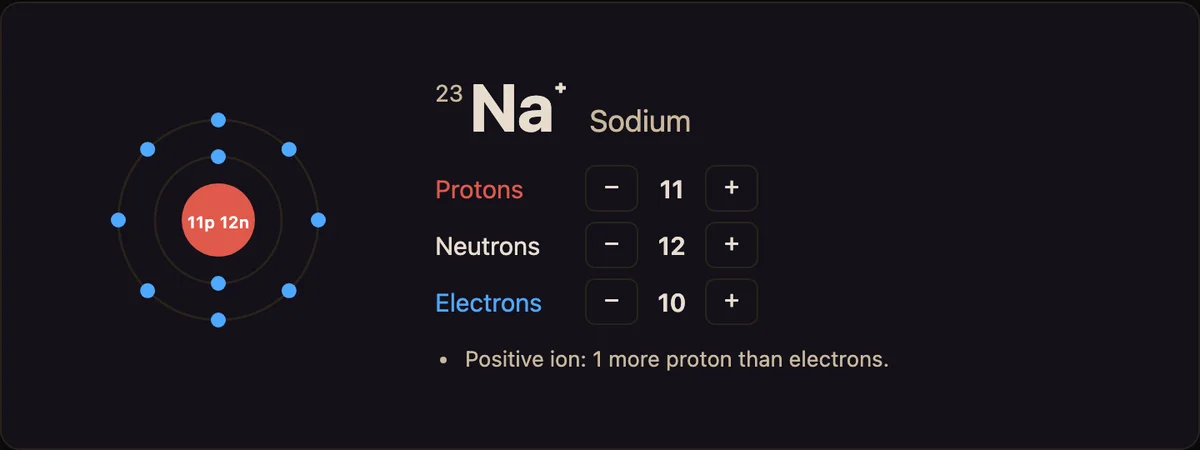
Touch the ideas, don’t just read them
Add a proton and watch carbon turn into nitrogen. Remove an electron and see an ion appear. Interactive models sit right inside the lessons, so every concept is something you can poke at.
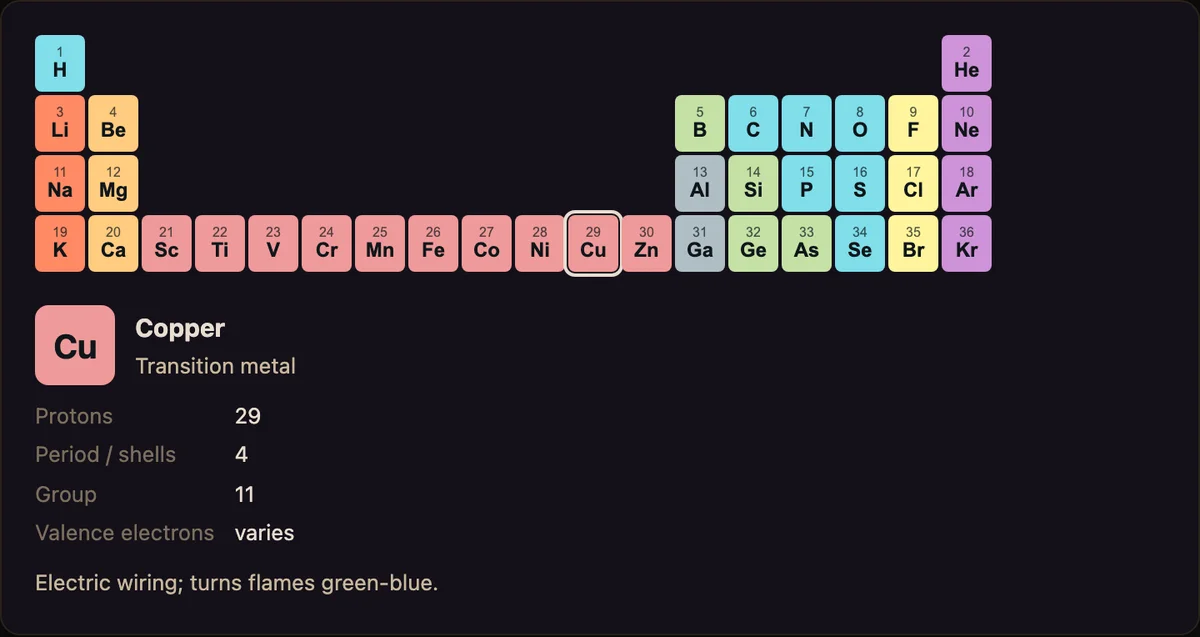
See the patterns behind the elements
The periodic table is a map, not a list. Click any element to see its family, its shells and its valence electrons — and where you meet it in everyday life.
Real experiments, safely, at home
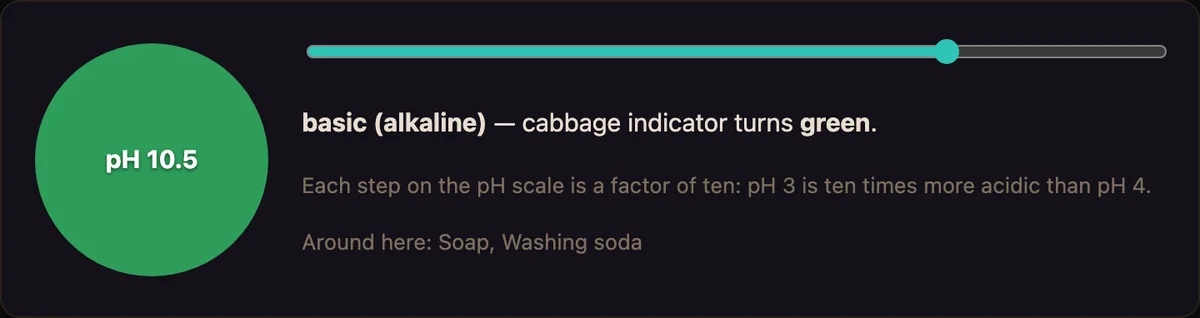
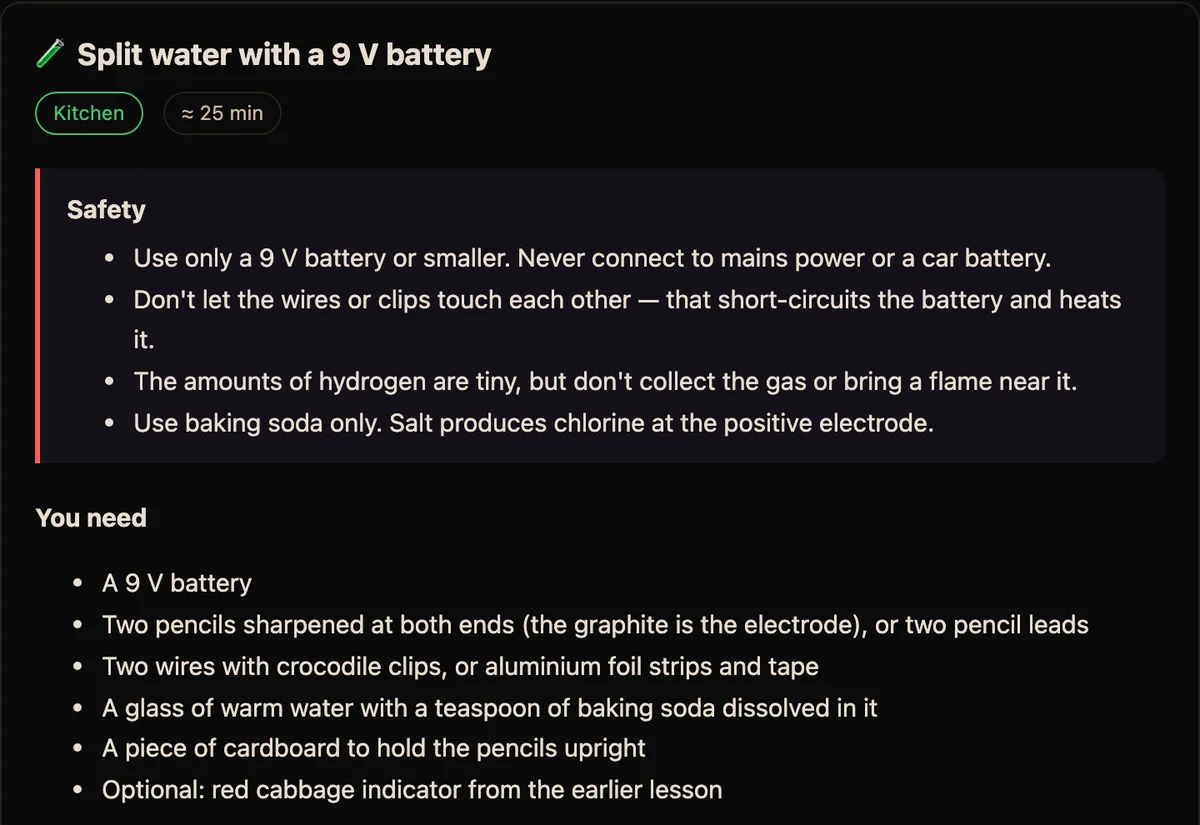
Split water with a 9 V battery, unmix the dyes in a marker, grow crystals, make a pH indicator from red cabbage. Every experiment lists exactly what you need, step by step, with clear safety notes — and explains what you just saw.
Turn fizz into numbers
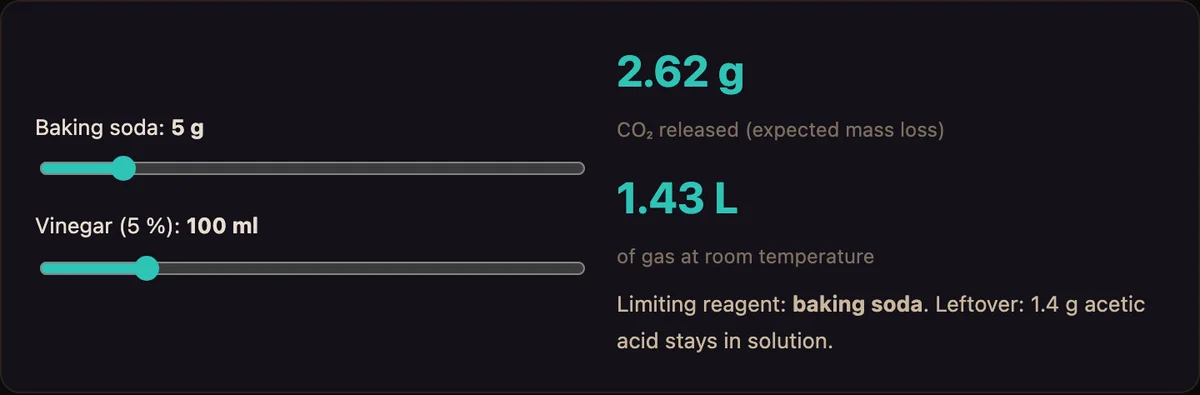
Predict how much gas a reaction should release, then weigh it on your kitchen scale. Calculators and quizzes help you check your thinking as you go.
Know when you’ve got it
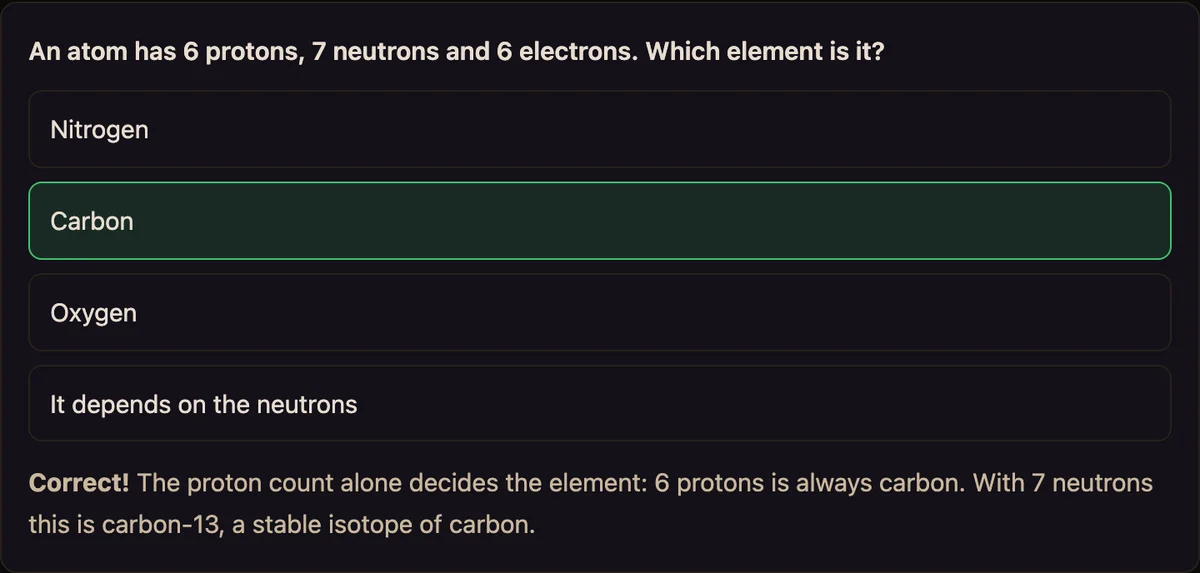
Short questions throughout each lesson give instant feedback and explain the reasoning, whether you picked the right answer or not. Mark lessons complete and watch your progress through the course.
From kitchen to lab
Every method in the course comes with the cheapest way to try it yourself, and what more becomes possible as you invest.
- €0
Kitchen
Red cabbage, baking soda, coffee filters, a 9 V battery. Real chemistry with what’s already in the cupboard.
- ≈ €20–300
Hobby kit
pH strips, a 0.01 g scale, syringes, safety glasses. Your observations become measurements.
- ≈ €300–2 000
Home lab
Glassware, a hotplate stirrer, a pH meter, a USB spectrometer. Titrations and colorimetry at home.
- Access, not ownership
Professional lab
GC, HPLC, ICP and NMR — what they do, and how to get a sample analysed without buying one.
What you’ll learn
Part 1 · Foundations — how chemistry works, how samples are analysed, and what you can test at home.
- 1
Matter and atomsAvailable now
Atoms, isotopes, electron shells and the periodic table.
- 2
Bonds, molecules and mixtures
How atoms stick together, and why salt dissolves but oil doesn’t.
- 3
Chemical reactions
Balancing equations, energy, rates and equilibrium.
- 4
Acids, bases and redox
pH, titration, rust, batteries and a first taste of organic chemistry.
- 5
How we analyse samples
Wet chemistry, chromatography, spectroscopy, mass spec and NMR.
- 6
The lab and its machines
What each instrument does, what goes in, what comes out — and what it costs.
- 7
Kitchen chemistryAvailable now
Eight real experiments with things you already own.
- 8
Levelling up your home lab
What each step of investment unlocks, ending with a tap-water analysis.
Start with your first atom
Ten minutes from now you’ll know what everything is made of.